
How to build organisations that withstand shocks

Four business leaders and MBS alumni share how they build organisational resilience long before a crisis hits.
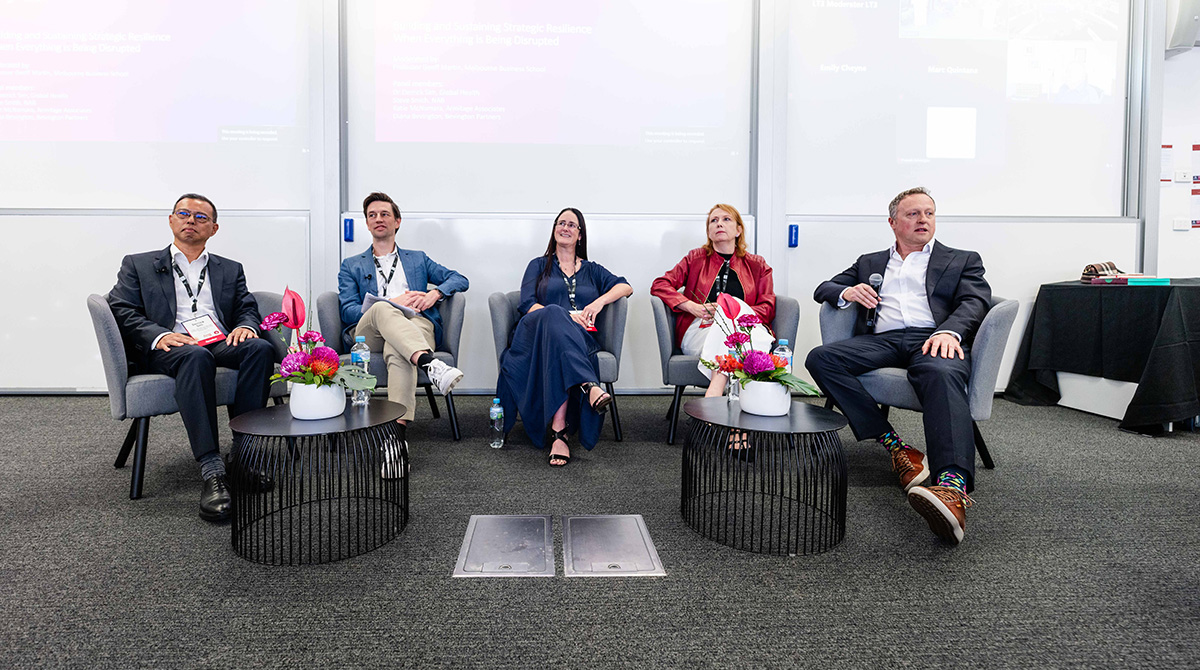
Leaders must navigate increasingly complex business environments, from shifting geopolitical landscapes and technological disruption to changing customer expectations.
For businesses to not only survive but thrive during volatile times, leaders must build organisational resilience before a crisis arrives.
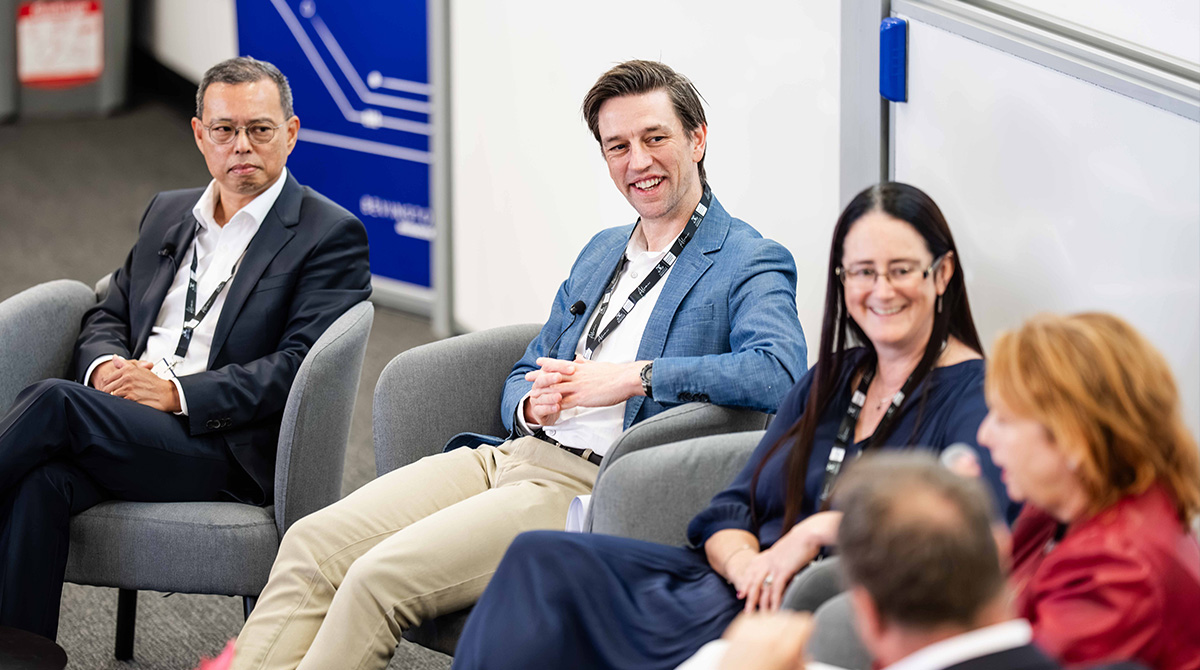
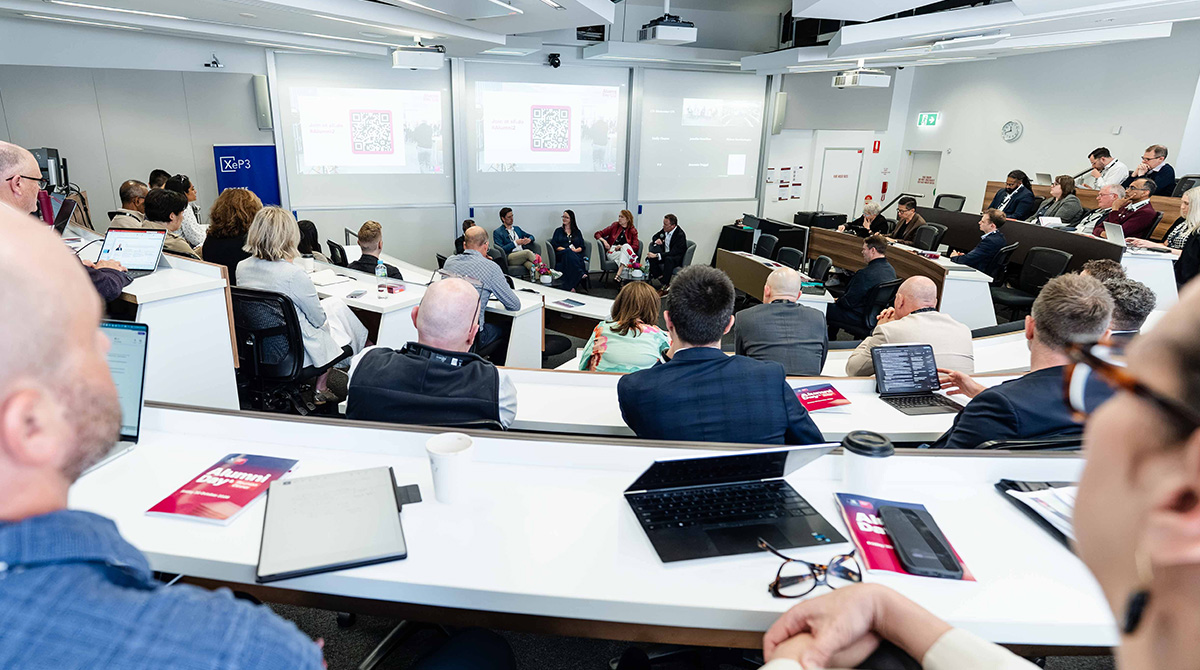
At the 2026 Alumni Day, sponsored by Bevington Partners, Professor of Strategy Geoff Martin (MBA 2001) spoke with four business leaders about their lessons for navigating disruption on the panel Building and Sustaining Strategic Resilience When Everything Is Being Disrupted.
Four lessons stood out.
1. Understand the context you’re operating in
Derrick Sim (MBA 2002), Executive Director of Global Health, Access and Financing at IFPMA, was Director of Vaccines Supply and Demand at Gavi, the Vaccine Alliance, when COVID-19 hit.
"You're going to have to build off reasonable assumptions based on past experience while understanding that you can't hold too tightly onto those because you are in a different era.
Strategic resilience and how you manage is actually not built at the time, it's built in experience and capabilities over time.
I think it's important to understand the context and the system that you're operating in. Because ultimately, your playbook, your operations, your expansion plans have to exist within a certain context.
My experience has shown resilience is not actually self-sufficiency.
I think it's actually quite the opposite. It's understanding where you need to build partnerships, alliances, whether it's supply networks or other service providers that help you get the job done."
2. Use customers as a source of market intelligence
Steve Smith (MBA 2014) is Executive, Global Capabilities – Corporate & Institutional Banking at NAB.
"I think it's much more about the ability for the organisation to adapt and thrive when there is a level of disruption and uncertainty in the market.
And I think that requires three things for us to have:
The first is planning around the strategy. The second part for me is your ability to sense what's happening in the market. And that's where we're quite fortunate in that we're plugged into every type of customer there is.
A lot of our sensing ability to know what's happening with the economy, what's happening across geopolitics and across the industry is that we're actually talking to our customers; we're listening to them.
And then the third part is your ability to react to those signals and make changes with that data."
3. Have a playbook for executing your strategy
Katie McNamara (MBA 2002) is Operating Partner at Armitage Associates and previously served as Chief Strategy & Customer Officer at Super Retail Group.
"When you're looking at entering into different markets, I think you need to be really clear around how does it apply from a strategic perspective?
Where have you got the right to play and where have you got the right to invest?
I often say hope is not a strategy because we often come out with a great pronouncement that this is what we're going to do, and then we neglect to follow up with how we're going to do it.
Those really granular choices in strategy are what will predicate whether we're going to be successful or not.
I think being clear around where your core competitive advantage comes from and then making sure that every strategic decision you make is linked to that and doing the pre-work really makes things a lot easier.
In an environment of increased ambiguity you need a playbook.
4. Free up organisational capacity to respond when crisis hits
Diana Bevington is the Chief Executive Officer of Bevington Partners and co-founder of XeP3.
"It's all about understanding what's going on internally. You have a lot of capability in your organisations and how do you actually translate strategy into action?
Because in the real world there's firefighting every day, crisis management, customer complaints, sending back products, reorganising, working with customers - all that's happening and the strategy is an ideal that everyone would like to achieve.
The research done with the University of Melbourne showed 36.1% of staff time across every sector is typically wasted time in an organisation – that’s almost 2 days every week.
That's all the workarounds, running around and fixing everything that should have been done correctly in the first place.
I think as leaders it's understanding and finding out what people are doing. Because when you're the CEO of a company, you can change anything, but what do you change?
You need to involve your people at different levels in the organisation to understand what the problems are and how they fix them.
What is the baseline, what are your big problems, what do you need to solve and what can you do right now to make your staff believe you're actually doing something and that you're making change?
Don't wait two years because they've given up by then."

For Organisations
Discover learning solutions for your organisation to unleash the power of your people.

Degree Programs
Whatever your career stage or aspirations, we have a program to suit your needs and develop your capabilities.

Alumni Community
Your career never stops advancing when you join Australia's most influential business network.

