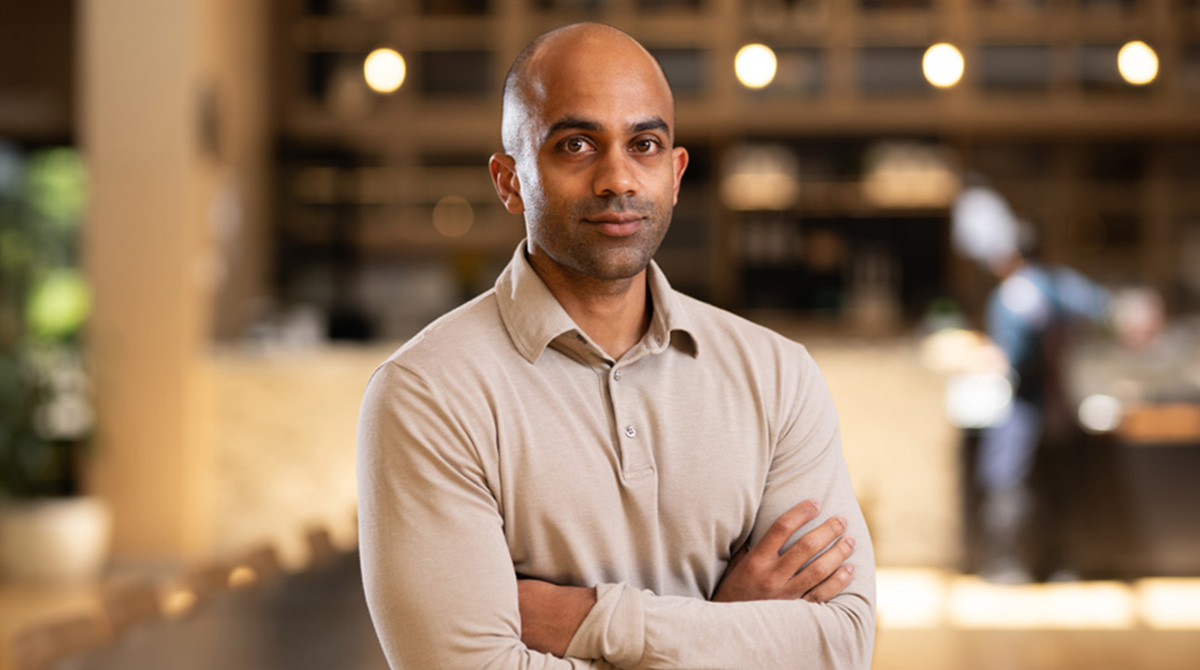
From commanding at sea to leading with impact

How a 26-year US Navy career, a chance meeting in Hobart and a Senior Executive MBA set Dale Heinken on the path to helping build Australia’s naval nuclear safety regulator.
- Name: Dale Heinken
- Current Role: Deputy Director-General, Australian Naval Nuclear Power Safety Regulator
- Program: Senior Executive MBA, Melbourne Business School
- Cohort: 2023-2024
Rising Through the Ranks
Dale Heinken grew up with a desire to serve and to be part of something bigger than himself. That pull took him to the US Naval Academy, and he’d spend the next 26 years in the US Navy, including command at sea and national-level strategic roles.
Heinken’s rise through the Navy came with a steady climb. As Commanding Officer of USS Freedom, he led a team of around 90 people. As Reactor Officer, he led approximately 450. By the time he commanded USS Boxer, he was responsible for more than 1,000 sailors. His Navy career also included serving as a strategic planner on the Joint Staff at the Pentagon.
.ashx)
Born in landlocked Oklahoma, his naval career took him around the world, including multiple deployments to the Arabian Gulf.
But his favourite port of call?
“On the way home we stopped in Hobart,” he said.
It was there that Heinken met his future wife, Amanda, in 1999. They married the following year and went on to have two daughters.
After retiring from the Navy, Heinken made good on a promise he had made to Amanda years earlier. In 2021, the family moved to Australia.

From the Navy to the Boardroom
Let’s talk about that life in Australia.
Soon after arriving, Heinken took on the leadership of AVT Australia, a supplier of imaging systems for intelligence and surveillance. As he moved into corporate leadership and running a business, he wanted to build fluency in disciplines such as financial reporting, marketing and commercial strategy. So, in 2023, he made good on a lifelong ambition first sparked reading the pages of Harvard Business Review, beginning the Senior Executive MBA at Melbourne Business School.
“In the Navy, I was responsible for large teams, significant resources and assets, but I wasn't running a commercial P&L," he said. "Suddenly I was running a company where profitability and commercial performance were part of the job.”
The Senior Executive MBA provided the formal grounding in business disciplines Heinken had been seeking. But just as much, he believed came from the room itself: sitting alongside people who had built careers in completely different industries and comparing what leadership looked like in his world with theirs.
“It’s all those intangibles coming together that create the experience,” he said.
Under his tenure, AVT evolved from a research-focused organisation into a multifaceted enterprise and achieved significant growth. The Senior Executive MBA played an important role in that journey, giving Heinken ideas and frameworks he could apply in real time. Challenges at AVT gave the classroom learning immediate context, while ideas from MBS could be taken straight back and tested with his team.
Uncharted Waters: Australian Nuclear Safety
Heinken's current role sits at the centre of one of the biggest shifts in Australian defence policy in a generation. In September 2021, Australia, the United States and the United Kingdom announced AUKUS. Its centrepiece was Australia's pathway to acquire and operate conventionally armed, nuclear-powered submarines.
That decision also raised a fundamental question: how should Australia independently regulate naval nuclear propulsion for the first time?
That is the challenge Heinken is now helping address as Deputy Director-General of the country's newly established Australian Naval Nuclear Power Safety Regulator. Simply put, it’s been established to provide independent assurance of nuclear safety across Australia's nuclear-powered submarine program.
“Australia is establishing a sovereign naval nuclear propulsion capability for the first time. Building the independent regulatory capability required to assure nuclear safety is both an enormous challenge and an extraordinary opportunity.”
Much of his work goes into building the regulator's capability and operating model, while engaging with stakeholders across government, industry and communities.
.ashx)
Heinken finds himself drawing on relationships from his MBA cohort.
“You've got people from not-for-profits all the way to big corporations in Australia. You get to interact with them, get their perspective, develop those relationships, see how they view things,” he said.
That's an experience he draws on in a role requiring engagement across a variety of stakeholders.
“That's been particularly useful in helping stand up a new regulator in an area of significant public interest. There are not-for-profits, state governments, companies and communities that all have an interest in the program. Understanding those different perspectives through the Senior Executive MBA has been particularly useful,” he said.
He continues to draw on that network today.
.ashx)
Asked to sum up his Senior Executive MBA experience in one word, Heinken doesn't hesitate.
“Stronger.”
Not because the program replaced what decades of leadership had taught him, but because it added to it: new disciplines, different perspectives and relationships that have endured well beyond the classroom.
For Heinken, who has spent more than two decades deliberately studying leadership, that process hasn't ended with command, an MBA or a senior executive role.
“I don't think you ever finish becoming a leader.”